
Nikon AF-P DX NIKKOR 70-300mm f/4.5-6.3G ED (non-VR)
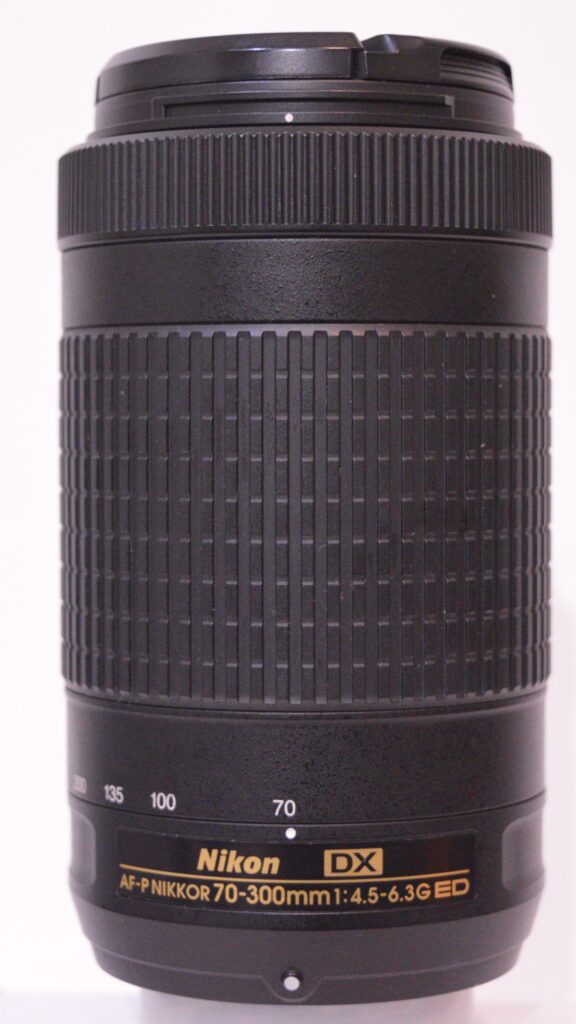
The used Nikon AF-P DX 70-300mm lens is one of the most practical telephoto zooms Nikon has produced for DX-format shooters — compact enough to carry all day, yet capable of reaching 300mm with quiet, fast pulse motor autofocus that makes it as useful for video as it is for stills.
Overview
Introduced in 2016, the AF-P DX NIKKOR 70-300mm f/4.5-6.3G ED was Nikon’s response to demand for a modern telephoto zoom designed around the smaller DX format. Rather than updating its legacy FX 70-300mm, Nikon built an entirely new optical formula from the ground up for APS-C sensor bodies, prioritising compact dimensions, light weight, and the new AF-P pulse motor autofocus system.
On a DX body the used Nikon AF-P DX 70-300mm lens delivers a 35mm equivalent range of 105–450mm — broad enough to cover wildlife, distant sports, portraits, and travel in a single lens. It measures 72mm in diameter by 125mm in length and weighs 400g (Nikon USA specification), making it one of the lightest 70-300mm telephoto zooms available for the F-mount. Note: Digital Camera World lists the weight of the VR variant at 414g; the non-VR version (this lens) is confirmed at 400g by Nikon USA.
Optical Construction
The optical formula consists of 14 elements arranged in 10 groups. Nikon includes one ED (Extra-low Dispersion) glass element, which is specifically engineered to reduce chromatic aberration — the colour fringing that can appear at high contrast edges, particularly at telephoto focal lengths. Nikon Super Integrated Coating is applied to minimise reflections, ghosting, and flare across the zoom range.
The minimum focus distance is 1.1m (3.7 ft), which — combined with the 300mm reach — produces a maximum reproduction ratio of 0.22x (approximately 1:4.5). This is practical for close-up photography of flowers, insects at a safe distance, and product details, though it does not qualify as true macro. The lens uses 7 diaphragm blades.
Autofocus Performance
The AF-P designation indicates a pulse motor (stepping motor) autofocus system — a significant advance over the older AF-S screw-driven SWM systems for certain shooting scenarios. The pulse motor operates nearly silently, which makes this lens a strong choice for video recording where traditional AF motor noise would be picked up by on-camera microphones.
In practice, autofocus is notably fast, especially at shorter focal lengths. There are no AF/MF switches on the lens barrel — autofocus mode and manual focus override are both managed through the camera’s menu system. Manual focus is fly-by-wire via the forward focus ring. The absence of barrel switches means there is no risk of accidentally toggling settings mid-shoot, though it does require camera menu access to switch modes.
Compatibility note: AF-P lenses communicate electronically with the camera body in a way that requires firmware support. They are not compatible with D3000, D5000, D7000, D60, and D40-series bodies, and several other older models. When used with D5, D4-series, D810-series, D800-series, Df, D750, D610, D600, D7200, D7100, D5500, D5300, and D3300, camera firmware must be updated to the latest version. Always verify compatibility for your specific body before purchasing.
Build Quality and Handling
The AF-P DX 70-300mm is built from quality plastics throughout, including the F-mount flange — which is plastic rather than the metal mount found on higher-end Nikon lenses. Digital Camera World notes this as less robust than metal, though still very durable in normal use. There is no weather sealing. The lens extends outward as you zoom toward 300mm, with the inner barrel extending approximately 50mm at maximum zoom.
The zoom ring is wide and easy to locate without looking, and rotates from 70mm to 300mm in roughly a quarter turn with markings at 70, 100, 135, 200, and 300mm. The filter thread is 58mm and does not rotate during focusing. The optional Nikon HB-77 bayonet lens hood is sold separately and is recommended. Dimensions: 72mm diameter × 125mm length. Weight: 400g.
Compatible Camera Bodies
This lens uses the Nikon F-Bayonet mount and is designed for DX-format (APS-C) bodies. It can also be mounted on FX full-frame bodies and will function in DX crop mode, though it is not designed for full-frame coverage. For full-frame use, Nikon’s AF-P NIKKOR 70-300mm f/4.5-5.6E ED VR is the appropriate choice.
Confirmed compatible DX bodies (with current firmware where required): D3500, D3400, D3300, D5600, D5500, D5300, D7500, D7200, D7100, D500.
Not compatible with: D3000, D3100, D3200, D5000, D5100, D7000, D90, D80, D70-series, D60, D50, D40-series, D300-series, D200, D100, D1-series, D2-series, D3-series, D700. These bodies cannot support AF-P communication and will not autofocus or may not meter correctly.
For use on Nikon Z-series mirrorless bodies, the FTZ or FTZ II adapter is required. AF-P lenses function with the FTZ adapter on Z bodies that support F-mount lenses.
Image Quality
For a lens at this price and weight class, image quality is genuinely strong. Centre sharpness is excellent from wide open through approximately f/8 across the zoom range. Edge sharpness is very good at maximum aperture and sharpens further from f/5.6, with the sweet spot between f/8 and f/11 (Photography Blog, tested on D7500). Focus Review reports sharpness as very good corner to corner, and notably good even at 300mm — which is often where budget telephoto zooms reveal their weaknesses most clearly.
Chromatic aberration is well controlled for the class, with the single ED element doing useful work. Some colour fringing is visible toward frame corners, particularly in the 70–135mm sector and at longer focal lengths, but this is correctable using in-camera lens correction on compatible bodies and in post-processing. Distortion is minimal across the zoom range — slight pincushion at 70mm, a little more noticeable in the 135–200mm range, dropping off again at 300mm, but not a practical issue at any focal length (Digital Camera World).
Bokeh quality is better than expected for a slow telephoto zoom. Thom Hogan (DSLRBodies) notes very controlled out-of-focus rendering with only minimal onion-skinning in specular highlights and modest edge colouration. Flare and ghosting are well controlled thanks to the Super Integrated Coating.
Full Technical Specifications
| Mount | Nikon F-Bayonet |
| Format | DX (APS-C); FX in DX crop mode |
| Focal Length | 70–300mm |
| Zoom Ratio | 4.3x |
| Maximum Aperture | f/4.5 |
| Minimum Aperture | f/32 |
| Optical Formula | 14 elements in 10 groups |
| ED Glass Elements | 1 |
| Diaphragm Blades | 7 |
| Autofocus | Yes — AF-P pulse (stepping) motor |
| Image Stabilization | No (this is the non-VR version) |
| Minimum Focus Distance | 1.1m (3.7 ft) |
| Maximum Reproduction Ratio | 0.22x |
| Angle of View (DX) | 22°50′ – 5°20′ |
| Filter Thread | 58mm |
| Dimensions (Diameter × Length) | 72mm × 125mm |
| Weight | 400g (14.2 oz) — Nikon USA |
| Coating | Nikon Super Integrated Coating |
| Distance Information | Yes |
| G-type | Yes (no aperture ring) |
Why Buy This Used Nikon Telephoto Zoom?
The used Nikon AF-P DX 70-300mm lens punches well above what its compact size and light weight might suggest. It delivers sharp, well-controlled images across a telephoto range that covers almost every real-world distance shooting scenario — wildlife at the treeline, sports from the sideline, portraits at social events, and architectural details from across the street. The pulse motor autofocus is genuinely fast and silent, and the absence of lens barrel switches means the camera body controls everything cleanly.
Buying used means getting this performance at a fraction of the new retail price, without sacrificing the optical quality. At Good Used Cameras, every lens is inspected and confirmed working before listing. The glass on this example is clear with no fog, scratches, or haze, and autofocus has been verified. It ships with front and rear caps, fast from Vancouver Island, BC.