
Canon EF 50mm f/1.4 USM
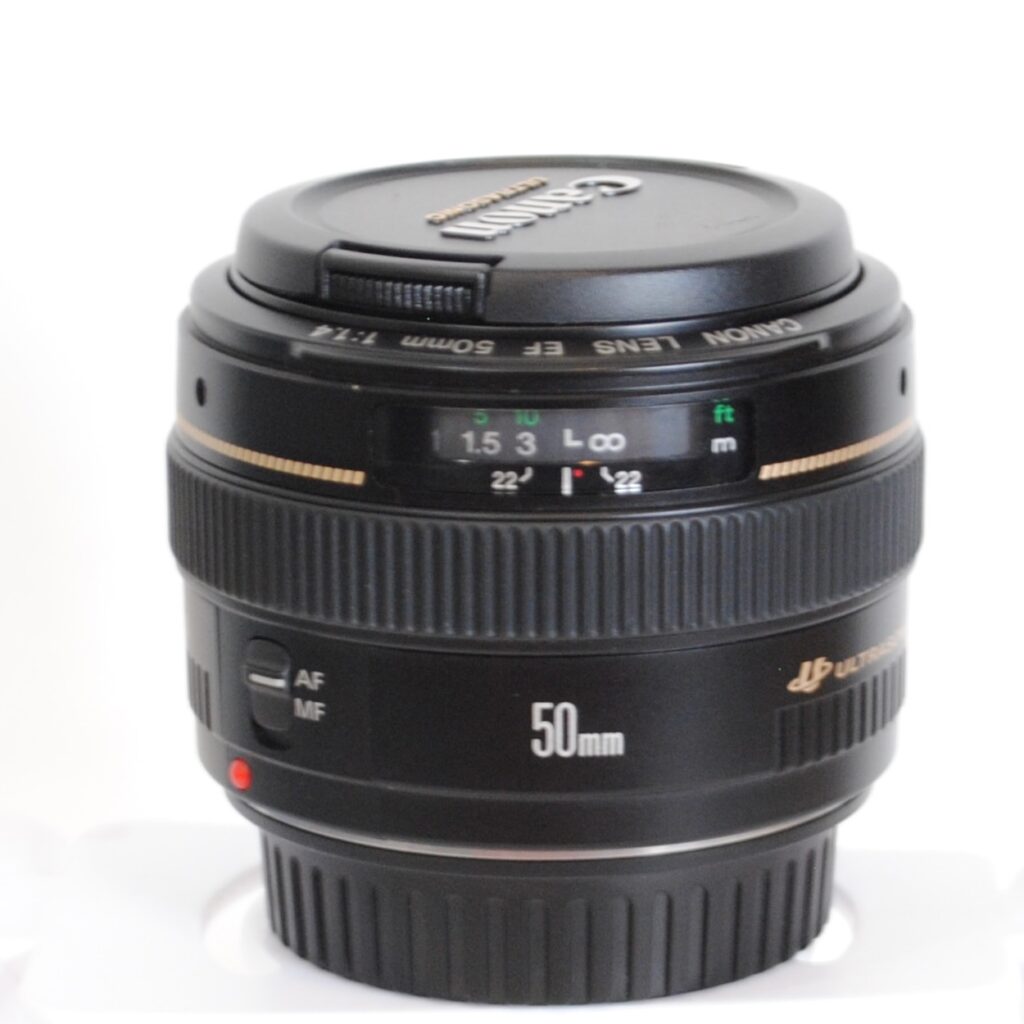
This Canon EF 50mm f/1.4 USM review covers a fast standard prime pairing an f/1.4 maximum aperture with Micro USM autofocus in a compact 290g body, delivering low-light capability and background separation that no kit zoom can match. On full-frame Canon bodies it’s a true standard lens; on APS-C bodies its 80mm equivalent focal length makes it an excellent short portrait lens.
Overview
The Canon EF 50mm f/1.4 USM is a full-frame standard prime first introduced in 1993 and manufactured continuously since — a record of longevity that reflects how useful this focal length remains. On a full-frame Canon body, 50mm produces a natural perspective close to the human field of view, making it well suited to street photography, documentary work, travel, and indoor events. On an APS-C body, the 1.6x crop factor delivers an 80mm equivalent field of view, placing it firmly in short portrait telephoto territory.
As a used Canon standard prime lens, the EF 50mm f/1.4 USM suits photographers who want a fast, lightweight lens for low light, portraits, and everyday shooting. At f/1.4, it gathers roughly four times more light than an f/2.8 zoom and around sixteen times more than a typical kit lens at its widest — a meaningful advantage in restaurants, venues, theatres, and other available-light interiors where slower lenses struggle.
Optical Construction
The Canon EF 50mm f/1.4 USM uses a 7-element, 6-group Gaussian optical design — a classical arrangement well suited to fast apertures, where controlling spherical aberration and astigmatism is the central challenge. Canon incorporated two high-refractive index elements into this design to address those aberrations and to reduce the soft glow that can affect wide-aperture lenses near maximum opening.
Super Spectra coating is applied throughout to control flare and ghosting, which matters when shooting toward bright windows, stage lighting, or street lamps at f/1.4. Minimum focus distance is 0.45m, giving a maximum magnification of 0.15x — not a macro lens, but enough for environmental portraits and moderate close-up work.
Autofocus Performance
Autofocus is driven by a Micro USM (Ultrasonic Motor) — quieter and faster than the arc-form drive and micro motor units found in Canon’s less expensive primes, though not as fast or as well-damped as the Ring USM used in Canon’s L-series lenses. In good to moderate light, focus is quick and quiet, suiting portraiture, street photography, and event work. In very low contrast or very low light, occasional hunting can occur.
Full-time manual focus override is available in One-Shot AF mode, allowing fine focus adjustments without switching modes. The front element extends slightly during focusing, but the filter thread does not rotate — useful with polarizers or graduated filters. The Canon EF mount provides full electronic compatibility with every Canon EOS DSLR, and the lens retains full autofocus and aperture control on Canon EOS R-series mirrorless bodies via the Canon EF-EOS R mount adapter (adapter not included).
Build Quality and Handling
The lens measures 73.8mm in diameter by 50.5mm in length and weighs 290g — compact and well balanced on any Canon body. Build quality sits a step above the entry-level EF 50mm f/1.8, with a more solid barrel, metal mount, and a focus ring that functions as a genuine manual control rather than an afterthought. There is no weather sealing. The 58mm filter thread is shared with several other Canon lenses, making filter ownership practical for those who shoot other EF lenses in that size.
Image Quality: Review Findings
Wide open at f/1.4, the lens produces a characteristic soft halation — a gentle glow around bright point sources — along with visible corner light fall-off on full-frame bodies. This is typical of fast primes at maximum aperture and can be used creatively for a warm, dreamy rendering in portraits. Centre sharpness is usable from f/1.4, improving noticeably by f/2 and reaching its peak around f/5.6.
Stopping down to f/2 or f/2.8 sharpens contrast, reduces chromatic aberration, clears vignetting on APS-C bodies, and produces clean, well-defined results. Corner performance on full-frame catches up by approximately f/2.8. Colour rendition is accurate and neutral. The 8-blade aperture produces rounded, smooth bokeh that separates subjects naturally from their backgrounds, making this a strong choice for portraiture and close-subject work from f/1.4 through f/4.
Full Technical Specifications
| Full Technical Specifications | |
|---|---|
| Focal Length | 50mm |
| Maximum Aperture | f/1.4 |
| Minimum Aperture | f/22 |
| Optical Formula | 7 elements in 6 groups |
| Special Elements | 2 high-refractive index elements |
| Angle of View | 46° (diagonal) |
| Diaphragm Blades | 8 (virtually circular) |
| Minimum Focus Distance | 0.45m (1.5ft) |
| Maximum Magnification | 0.15x |
| AF Actuator | Micro USM, full-time manual focus override |
| Image Stabilizer | None |
| Filter Thread | 58mm |
| Dimensions (Diameter x Length) | 73.8mm x 50.5mm |
| Weight | 290g |
| Mount | Canon EF (full-frame and APS-C compatible) |
| Coating | Super Spectra Coating |
Full manufacturer specifications for the Canon EF 50mm f/1.4 USM are available on Canon U.S.A.’s official support page.
Why Buy This Used Canon Standard Prime Lens?
Buying this used Canon standard prime lens is a practical way to get genuine f/1.4 low-light performance and creative depth-of-field control without the cost of buying new. The Gaussian optical formula, Micro USM autofocus, and 8-blade aperture in a well-maintained example perform exactly as they did when new — none of these components degrade meaningfully with normal use.
Every lens we sell is fully tested for autofocus accuracy, focus ring smoothness, and glass clarity before it’s listed, so you get the same fast, versatile standard prime performance at a fraction of the cost of buying new — with the added benefit of giving a well-built lens a second life.