
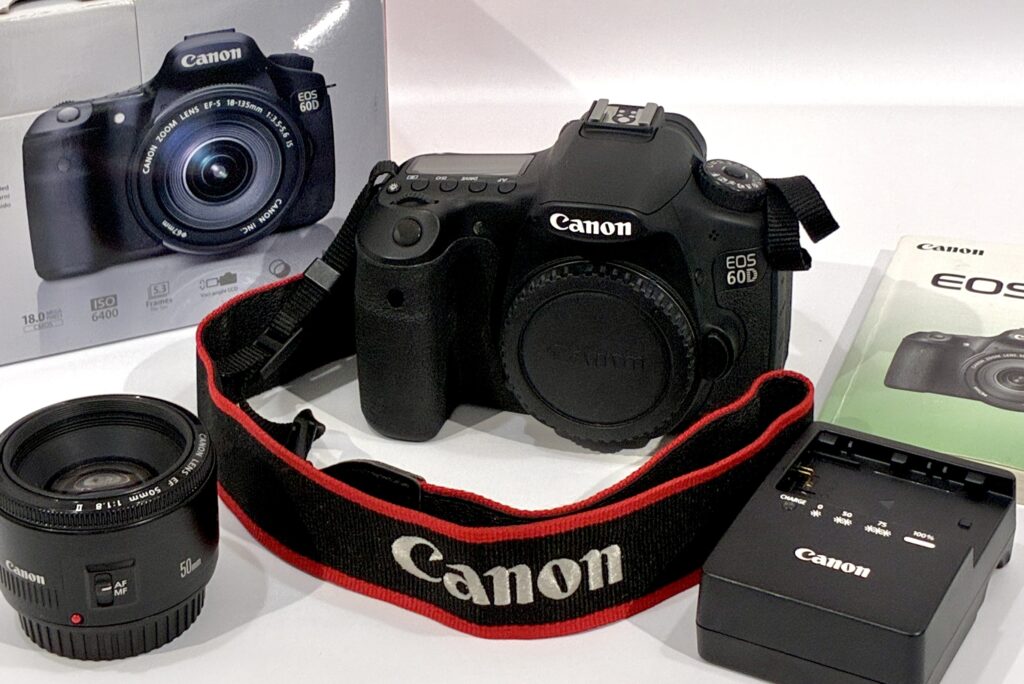
Canon EOS 60D
Available in our store: View Store Listing
Overview
A used Canon EOS 60D camera bridges the gap between Canon’s Rebel line and its pro-leaning EOS 7D, giving enthusiast shooters twin control dials, a bigger viewfinder, and a fully articulating screen without the flagship price tag. At used prices today, it remains one of the most capable and affordable ways into Canon’s EF/EF-S lens ecosystem.
Announced in August 2010 as the successor to the EOS 50D, the Canon EOS 60D was the first EOS body to introduce a vari-angle LCD monitor, and it slotted between the Rebel series and the EOS 7D in Canon’s enthusiast lineup. It was succeeded by the EOS 70D. The camera uses an APS-C sized CMOS sensor with a 1.6x crop factor, is built around Canon’s EF-S mount (accepting both EF and EF-S lenses), and pairs a DIGIC 4 image processor with a body that measures 144.5 x 105.8 x 78.6mm and weighs approximately 755g with battery and card installed.
Sensor & Image Quality
The 60D uses a 22.3 x 14.9mm APS-C CMOS sensor with approximately 18.0 effective megapixels, producing a maximum image size of 5184 x 3456 pixels at a 1.6x crop factor. It shoots RAW (Canon CR2), JPEG, and simultaneous RAW+JPEG. Native ISO runs 100–6400, expandable to 12800 (H). Reviewers at the time, including Imaging Resource and Macworld, considered high-ISO noise well controlled for an APS-C sensor of this generation, particularly through ISO 3200. The DIGIC 4 processor handles 14-bit image processing and supports Canon’s Picture Style system (Standard, Portrait, Landscape, Neutral, Faithful, Monochrome, plus user-defined styles) along with in-camera creative filters.
Autofocus System
Autofocus uses a 9-point AF system with all 9 points cross-type, offering auto or manual point selection. AF modes include One-Shot, AI Servo, and AI Focus. In Live View, the camera adds FlexiZone Single, FlexiZone Multi, Face Detection, and Quick (mirror-flip phase-detection) AF modes. Metering is handled by a 63-zone Dual-layer (iFCL) metering sensor, with Evaluative, Partial, Spot, and Centre-weighted Average modes available. Real-world reviews from this generation note the 9-point system as accurate but modest by today’s standards, with a center point rated to f/2.8 sensitivity for extra precision with fast lenses.
Shooting Performance
Continuous shooting tops out at 5.3 fps, with a buffer rated by Canon at 58 Large/Fine JPEGs or 16 RAW images. Shutter speed range is 1/8000 sec to 30 sec plus Bulb, with flash X-sync at 1/250 sec. The camera uses a single SD/SDHC/SDXC card slot. Battery is the Canon LP-E6 Li-ion pack, CIPA-rated at approximately 1,100 shots per charge — a notable jump over the 50D’s BP-511A battery, and the first use of the LP-E6 in Canon’s xxD line. The optional BG-E9 battery grip accepts one or two LP-E6 packs or six AA cells.
Video Capabilities
The 60D records Full HD 1920×1080 video at selectable 24p (23.976), 25p, or 30p (29.97) frame rates, plus 1280×720 at 50p/60p and 640×480 SD at 50p/60p. Footage is saved as .MOV files using H.264 (MPEG-4 AVC) compression, with individual clips limited to roughly 29 minutes 59 seconds or a 4GB file size, whichever comes first. Audio is captured via a built-in monaural microphone, with a 3.5mm jack for an external stereo microphone and manual audio level control. There is no headphone jack, so audio can’t be monitored during recording.
Viewfinder & Display
The viewfinder is an eye-level pentaprism with approximately 96% coverage and 0.95x magnification. The LCD is a 3.0-inch fully articulating Clear View II screen with 1,040,000 dots in a 3:2 aspect ratio matching the sensor — the first vari-angle screen in EOS history. It is not a touchscreen. Live View AF is available in FlexiZone Single, FlexiZone Multi, Face Detection, and Quick AF modes.
Body, Controls & Connectivity
Body dimensions are 144.5 x 105.8 x 78.6mm at approximately 755g (CIPA, with battery and card). Construction uses an aluminum chassis with polycarbonate-and-glass-fiber body panels — lighter than the magnesium-alloy 50D, though Canon has not officially claimed weather or dust sealing for the 60D. The mode dial offers Full Auto, Flash Off, Creative Auto, Portrait, Landscape, Close-up, Sports, Night Portrait, Program AE, Shutter-priority AE, Aperture-priority AE, Manual, Bulb, Custom, and Movie positions, and the camera introduced a Multi-Control Dial combining the earlier Multi-Controller and Quick Control Dial. Connectivity includes a Mini HDMI output, USB 2.0 Hi-Speed, a 3.5mm external mic jack, and a standard hot shoe. There is no built-in Wi-Fi or Bluetooth — both were added later, in the EOS 70D.
Compatible Lenses & Accessories
The EF-S mount accepts Canon’s full range of EF and EF-S lenses, giving access to one of the largest lens ecosystems in the DSLR world. This unit includes the Canon EF 50mm f/1.8 STM, a compact prime with a 50mm focal length (80mm full-frame equivalent on this body’s 1.6x crop sensor), maximum aperture of f/1.8, and minimum aperture of f/22. It uses a 6-element, 5-group optical design with Super Spectra coating, a 7-blade circular diaphragm for smooth background blur, and a gear-type STM stepping motor for quiet, near-silent autofocus with full-time manual override. Minimum focus distance is 0.35m with a maximum magnification of 0.21x, filter thread is 49mm, and the lens weighs approximately 159g. It does not include image stabilization. Compatible accessories for the body include the BG-E9 battery grip, wired or wireless remote control, and Canon’s EX-series Speedlites via E-TTL II.
Full Technical Specifications
| Camera Type | Digital SLR, APS-C |
| Lens Mount | Canon EF-S (EF/EF-S compatible) |
| Sensor Format | APS-C |
| Sensor Size | 22.3 x 14.9mm CMOS |
| Effective Pixels | Approx. 18.0 megapixels |
| Maximum Image Size | 5184 x 3456 pixels |
| Crop Factor | 1.6x |
| Image Processor | DIGIC 4 |
| ISO Range | 100–6400, expandable to 12800 (H) |
| Autofocus System | 9-point AF, all cross-type |
| AF Modes | One-Shot, AI Servo, AI Focus; Live View: FlexiZone Single/Multi, Face Detection, Quick |
| Metering Sensor | 63-zone Dual-layer (iFCL) metering |
| Shutter Speeds | 1/8000–30 sec plus Bulb; X-sync 1/250 sec |
| Continuous Shooting | 5.3 fps; buffer 58 Large/Fine JPEG or 16 RAW (Canon-rated) |
| Video | 1080p at 24/25/30p, 720p at 50/60p, 640×480 at 50/60p; MOV, H.264 |
| Viewfinder | Eye-level pentaprism, 96% coverage, 0.95x magnification |
| Monitor | 3.0″ Vari-angle Clear View II LCD, 1,040,000 dots, non-touch |
| Storage | SD/SDHC/SDXC, single slot |
| Connectivity | Mini HDMI, USB 2.0 Hi-Speed, 3.5mm mic jack, hot shoe; no Wi-Fi/Bluetooth |
| Battery | LP-E6 Li-ion, CIPA-rated approx. 1,100 shots |
| Body Dimensions | 144.5 x 105.8 x 78.6mm |
| Body Weight | Approx. 755g (CIPA, with battery and card) |
| Weather Sealing | Not officially claimed by Canon |
| Wi-Fi | No |
| Bluetooth | No |
| Hot Shoe | Yes |
| Announced | August 2010 |
| Kit Lens | Canon EF 50mm f/1.8 STM |
| Kit Lens Elements/Groups | 6 elements in 5 groups |
| Kit Lens VR/IS Rating | None (no image stabilization) |
| Kit Lens Filter Thread | 49mm |
| Kit Lens Min. Focus Distance | 0.35m (13.8 in) |
| Kit Lens Weight | Approx. 159g (5.6 oz) |
Why Buy This Used Canon EOS 60D?
A used Canon EOS 60D still delivers a genuinely capable enthusiast shooting experience at a fraction of its original cost. At launch, the 60D body carried an approximate retail price of $1,099 USD (body only; pricing varied by region and by which kit lens was bundled). Used pricing today puts that same twin-dial control layout, articulating screen, and 9-point cross-type AF system within easy reach. Key strengths of this specific model: the industry-first vari-angle LCD for awkward-angle shooting and video work, a DIGIC 4 processor that still holds up well for stills through moderate ISOs, and full manual video control that made it a favorite among budget-minded filmmakers. Paired with Canon’s EF/EF-S mount, it opens the door to one of the largest lens ecosystems available — including the compact, fast EF 50mm f/1.8 STM included with this unit. Every camera we sell has been inspected and tested at Good Used Cameras before listing.