
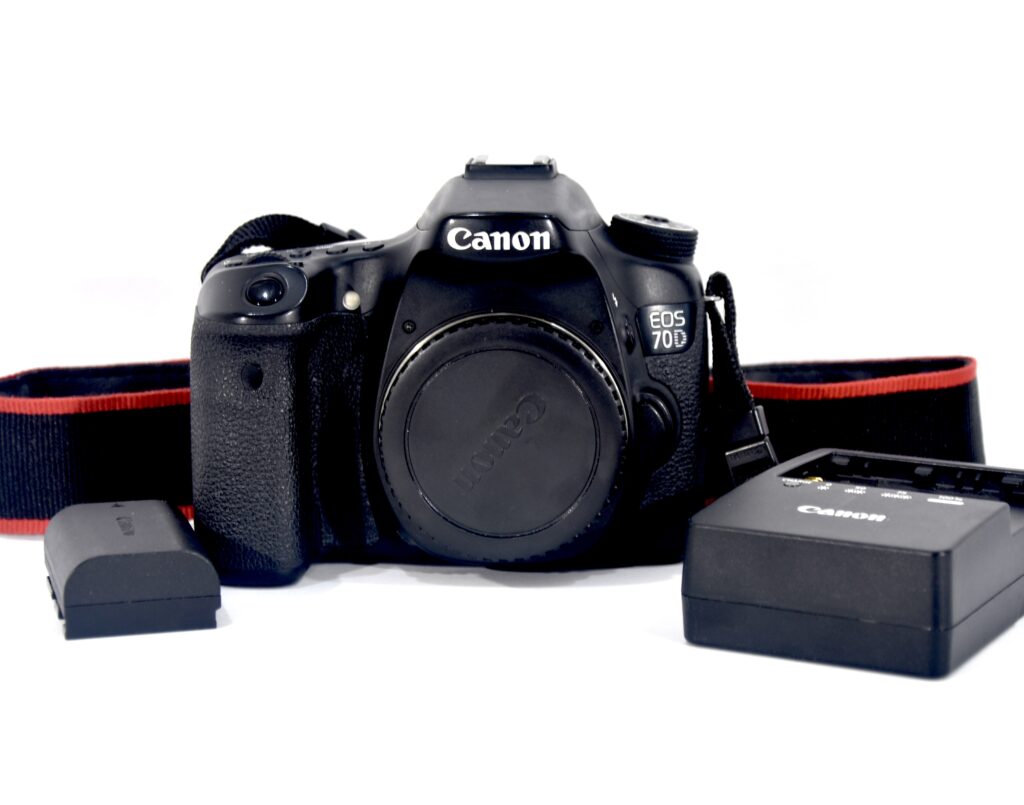
CANON EOS 70D
Overview
Canon announced the Canon EOS 70D on July 2, 2013, as the successor to the EOS 60D and a step-up option for photographers moving beyond entry-level Rebel-series bodies. Its headline feature at launch was Dual Pixel CMOS AF, the first on-sensor phase-detection autofocus system built into a Canon DSLR, aimed squarely at improving autofocus speed during Live View shooting and video recording. The 70D was succeeded by the EOS 80D in early 2016.
It’s built around an APS-C format sensor paired with Canon’s DIGIC 5+ processor, in a body measuring 139.0 x 104.3 x 78.5mm and weighing approximately 755g (body only, with battery and card), using the Canon EF/EF-S lens mount.
Sensor & Image Quality
The EOS 70D uses a 22.5 x 15.0mm APS-C CMOS sensor with approximately 20.2 effective megapixels (20.9 million total pixels), giving a 1.6x crop factor and a maximum JPEG/RAW image size of 5472 x 3648 pixels. It records 14-bit RAW in three sizes (RAW, M-RAW, S-RAW), JPEG in Fine and Normal quality settings, and supports simultaneous RAW+JPEG recording in any combination. Native ISO runs 100–12800, expandable to ISO 25600 (H) for stills; video ISO tops out lower, at 100–6400 native with a 12800 (H) expansion. Reviewers at the time of launch (Cameralabs, TechRadar) generally rated image quality as strong through the mid-ISO range, with noise becoming more noticeable at the higher expanded settings — typical for an APS-C sensor of this generation. The DIGIC 5+ processor supports Auto Lighting Optimizer, Highlight Tone Priority, Multi Shot Noise Reduction, seven Picture Styles plus three user-defined slots, and in-camera RAW processing during playback.
Autofocus System
The 70D uses a 19-point AF module, all 19 points cross-type, with the center point rated for extra sensitivity at f/2.8. AF modes include One Shot, AI Servo, and AI Focus, with automatic 19-point selection or manual single-point/zone selection. Canon notes that the peripheral cross-type points will not function as cross-type with a small number of older lenses (EF 35-80mm f/4-5.6 II/III/USM, EF 35-105mm f/4.5-5.6 USM, and EF 80-200mm f/4.5-5.6 II) — worth knowing if you’re pairing this body with older glass. Metering uses a 63-zone Dual Layer SPC sensor with Evaluative, Partial, Spot, and Center-weighted modes. In Live View, Dual Pixel CMOS AF provides continuous phase-detection autofocus across approximately 80% of the frame both vertically and horizontally, which was a genuine leap over Canon’s earlier contrast-detection Live View AF and remains a strong point of this camera for video and Live View stills work.
Shooting Performance
Continuous shooting tops out at approximately 7 fps, with a buffer rated by Canon at up to 65 Large/Fine JPEGs (on a UHS-I card) or 16 RAW files — Canon notes maximum fps and buffer depth can be reduced depending on camera settings and lighting conditions, so treat these as best-case figures rather than guarantees. Shutter speed range is 30–1/8000 sec plus Bulb, using an electronically-controlled focal-plane shutter (there is no separate electronic-shutter mode; “silent” drive modes use the same mechanical shutter at reduced sound). Storage is a single SD/SDHC/SDXC slot, UHS-I compatible. Power comes from the LP-E6 battery, CIPA-rated for approximately 920 shots at 23°C (850 at 0°C). We haven’t independently re-tested real-world battery life beyond this CIPA figure.
Video Capabilities
Maximum video resolution is 1920×1080 at 29.97/25/23.976 fps (selectable intra-frame or inter-frame compression), with 1280×720 available at 59.94/50 fps and 640×480 at 29.97/25 fps. Files record as MOV using H.264 compression with Linear PCM audio. Maximum clip length is 29 minutes 59 seconds, or until the file reaches 4GB (a new file starts automatically if you keep rolling). Audio comes from a built-in monaural microphone, with a 3.5mm external stereo microphone input — there is no headphone jack for audio monitoring. There’s no 4K option and no built-in ND filter, both worth flagging for video-focused buyers used to newer bodies.
Viewfinder & Display
The optical viewfinder is a pentaprism design with approximately 98% coverage and 0.95x magnification, an eyepoint of about 22mm, and -3 to +1 dioptre adjustment. The rear LCD is a 3.0-inch vari-angle touchscreen (Canon’s ClearView II panel) with 1,040,000 dots and approximately 100% coverage. It’s fully articulated and touch-enabled, supporting Touch AF. In Live View, autofocus uses Dual Pixel CMOS AF with face detection and tracking, plus FlexiZone-Multi and FlexiZone-Single area modes.
Body, Controls & Connectivity
The body measures 139.0 x 104.3 x 78.5mm and weighs approximately 755g body-only (CIPA testing standard, including battery and card), with a chassis built from aluminum and polycarbonate resin reinforced with glass and conductive fiber. The mode dial covers Scene Intelligent Auto, No Flash, Creative Auto, an SCN group (Portrait, Landscape, Close-up, Sports, Night Portrait, Handheld Night Scene, HDR Backlight Control), Program AE, Shutter-priority AE, Aperture-priority AE, Manual, Bulb, and one Custom position. Connectivity includes built-in Wi-Fi for image sharing and remote control via Canon’s EOS Remote app; there is no Bluetooth. It has a mini HDMI output (HDMI-CEC compatible), Hi-Speed USB (USB 2.0), and a standard multi-function hot shoe.
Compatible Lenses & Accessories
The EOS 70D uses Canon’s EF/EF-S mount and is compatible with the full range of EF and EF-S lenses, giving a 1.6x equivalent focal length multiplier on any lens mounted. This body is sold as body only — no lens is included with this unit. Compatible accessories include the BG-E14 battery grip, RS-60E3 remote switch, RC-6 wireless remote controller, and Canon Speedlites via E-TTL II with wireless multi-flash support.
Full Technical Specifications
| Camera Type | Digital AF/AE single-lens reflex (DSLR) camera with built-in flash |
| Lens Mount | Canon EF/EF-S |
| Sensor Format | APS-C CMOS |
| Sensor Size | 22.5mm x 15.0mm |
| Effective Pixels | Approx. 20.2 megapixels (20.9 megapixels total) |
| Maximum Image Size | 5472 x 3648 pixels (JPEG 3:2 / RAW) |
| Crop Factor | 1.6x |
| Image Processor | DIGIC 5+ |
| ISO Range | 100–12800 native (expandable to 25600); movie: 100–6400 native (expandable to 12800) |
| Autofocus System | 19-point AF, all 19 points cross-type |
| AF Modes | One Shot, AI Servo, AI Focus |
| Metering Sensor | 63-zone Dual Layer SPC, TTL full-aperture |
| Shutter Speeds | 30–1/8000 sec, plus Bulb |
| Continuous Shooting | Approx. 7 fps (up to 65 JPEG on UHS-I card / 16 RAW, per Canon) |
| Video | 1080p up to 29.97fps, 720p up to 59.94fps, MOV/H.264 |
| Viewfinder | Pentaprism, approx. 98% coverage, 0.95x magnification |
| Monitor | 3.0″ vari-angle touchscreen, 1,040,000 dots, approx. 100% coverage |
| Storage | SD/SDHC/SDXC (UHS-I), single slot |
| Connectivity | Built-in Wi-Fi, mini HDMI, USB 2.0 (Hi-Speed), hot shoe. No Bluetooth. |
| Battery | LP-E6, CIPA-rated approx. 920 shots (23°C) |
| Body Dimensions | 139.0 x 104.3 x 78.5mm |
| Body Weight | Approx. 755g (body only, with battery and card) |
| Weather Sealing | Not independently confirmed — see fact-check note below |
| Wi-Fi | Yes, built-in |
| Bluetooth | No |
| Hot Shoe | Yes |
| Announced | July 2, 2013 |
| Kit Lens | Body Only |
Why Buy This Used Canon EOS 70D?
A used Canon EOS 70D body remains a genuinely capable enthusiast DSLR, and buying it used is where the value really shows. At launch in July 2013, Canon priced the 70D at approximately $1,199 USD body only — used pricing today gets you the same 19-point all cross-type AF system, Dual Pixel CMOS AF for fast Live View and video focusing, and a fully articulated touchscreen for a fraction of that. Key strengths of this specific body: reliable cross-type autofocus across the frame, genuinely useful Live View/video autofocus for its era, built-in Wi-Fi for wireless transfer and remote control, and a mode dial and control layout that still feels current. As an EF/EF-S mount body, it opens the door to one of the largest new-and-used lens ecosystems in photography. Every camera we sell has been inspected and function-tested in-house at Good Used Cameras before listing — see the attributes panel on the store listing for this unit’s specific condition grade and shutter count.